



You pour time into the perfect photo, choose a great filter, and hit post — then watch the likes trickle in like a slow drip. The problem is rarely the image. It’s the caption. A weak caption tells the algorithm there’s nothing worth amplifying, and your audience scrolls right past. The good news is that crafting captions that actually drive engagement is a learnable skill, not a mystery. This guide walks you through the psychology of virality, the essential elements every strong caption needs, a step-by-step writing workflow, and the most common mistakes that quietly kill your reach.
Table of Contents
- What makes a caption go viral?
- Essential elements of a viral caption
- Step-by-step: How to write a viral caption
- Avoiding common mistakes and troubleshooting low engagement
- The uncomfortable truth about viral captions: What most guides miss
- Level up your captions with curated resources
- Frequently asked questions
Key Takeaways
| Point | Details |
|---|---|
| Caption length matters | Optimal Instagram captions are usually 150-220 words for best engagement. |
| Encourage interaction | Questions and reply-inviting CTAs boost comments and reach. |
| Personalization beats generic | Customize AI-generated captions to avoid sounding bland. |
| Avoid overstuffing | Too many hashtags or vague calls-to-action reduce credibility and engagement. |
| Test and adapt | Batch write, test different approaches, and use analytics to refine your strategy. |
What makes a caption go viral?
Virality sounds like magic, but it’s mostly mechanics. In the context of social media captions, “going viral” means your post earns rapid shares, a flood of comments, and sustained interaction well after it first appears in people’s feeds. The algorithm notices that momentum and pushes the post to even more users, creating a feedback loop that can multiply your reach by hundreds or even thousands of times.
One of the biggest decisions you’ll face is caption length. Short captions create immediate impact. They’re punchy, scannable, and work brilliantly for humor, bold statements, or aesthetic posts where the image does most of the talking. You can find great examples of this approach in these one-word caption examples that prove less is sometimes more. On the other hand, longer captions build context, tell stories, and invite deeper conversation. Research shows that longer captions drive higher comment rates and algorithmic engagement on Instagram, with the sweet spot landing around 150 to 220 words.
The algorithm piece is critical. Platforms like Instagram and TikTok prioritize posts that generate replies and back-and-forth conversations, not just passive likes. Posts that encourage replies and interaction can boost engagement by 21 to 42 percent. That’s a massive lift from a simple tweak in how you end your caption.
Here’s what separates captions that get shared from those that get ignored:
- Emotional resonance. People share what makes them feel something, whether that’s laughter, nostalgia, inspiration, or even mild outrage.
- Relatability. Captions that make readers think “this is literally me” earn instant saves and shares.
- A clear hook in the first line. On most platforms, only the first one or two lines show before the “more” button. That opener has to earn the tap.
- A reason to comment. Questions, fill-in-the-blanks, or polarizing opinions give people a reason to type something.
“The best captions don’t just describe the image. They create a conversation that the image alone never could.”
Celebrity accounts often go viral with a single sentence because their audience is primed to engage. Brand accounts, by contrast, tend to perform best when they write captions that feel personal and community-driven rather than corporate. Study both styles and you’ll notice the common thread: they both make the reader feel something and give them a reason to respond. For inspiration on what high-performing captions look like in practice, check out these fire Instagram captions that consistently drive strong engagement.
Essential elements of a viral caption
Now that you know what a viral caption needs, see how to assemble these elements in practice. Think of a great caption like a recipe. Miss one ingredient and the whole dish falls flat. Here’s a breakdown of the core components:
| Element | What it does | Example |
|---|---|---|
| Hook | Grabs attention in the first line | “Nobody tells you this about Mondays…” |
| Voice and tone | Builds brand personality and trust | Playful, bold, warm, or witty |
| Emotional trigger | Makes readers feel and share | Nostalgia, humor, inspiration, FOMO |
| Call to action (CTA) | Directs what to do next | “Drop your answer below” |
| Hashtag strategy | Extends discoverability | 3 to 5 targeted, relevant tags |
| Brevity and clarity | Keeps readers reading | No filler, no fluff |
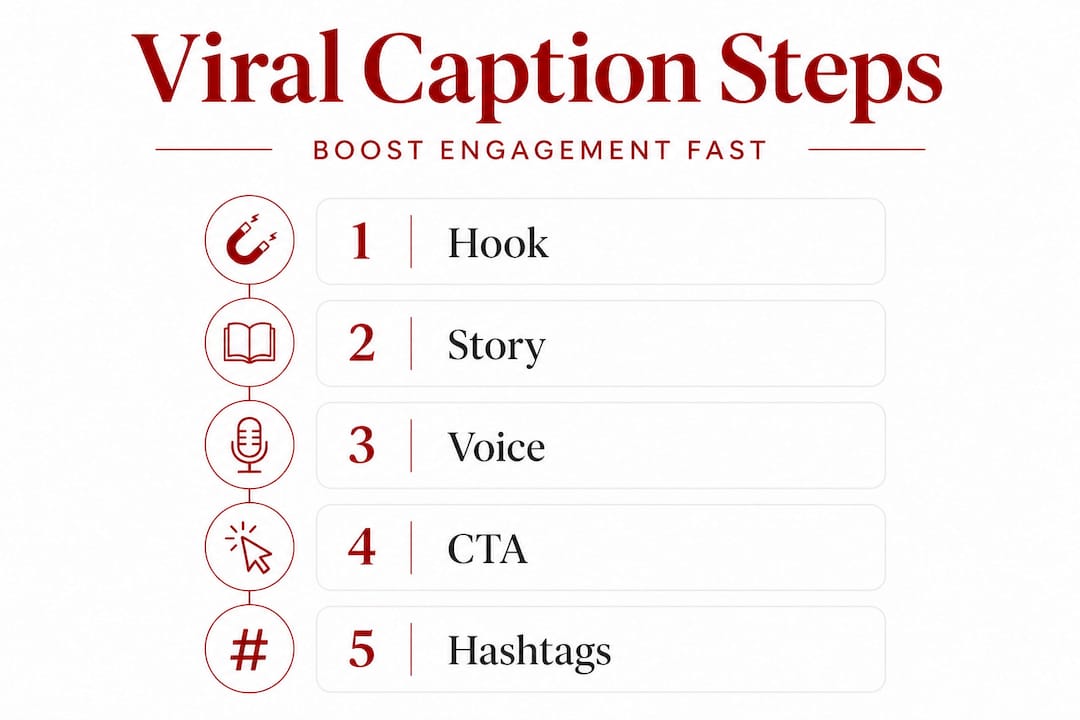
Each of these elements plays a specific role. The hook gets the click. The voice keeps them reading. The emotional trigger makes them care. The CTA converts passive readers into active commenters. Hashtags extend your reach beyond your current followers. And brevity makes sure none of these elements get buried in a wall of text.
Common mistakes that undercut even well-intentioned captions include:
- Using too many hashtags, which can look spammy and reduce your post’s overall performance
- Writing vague CTAs like “check the link in bio” without giving a reason to actually do it
- Making every post about yourself or your product without offering value to the reader
- Copying trending captions word for word without adding your own personality
- Forgetting to proofread, because typos break trust instantly
Pro Tip: Use AI tools to generate your first draft quickly, then rewrite at least 40 percent of it in your own voice. The draft gives you structure; your personality gives it life. This is especially important for themed posts. If you’re writing for a milestone moment, look at curated collections like these graduation caption ideas or Wednesday caption inspiration to spark ideas you can then make your own.
Step-by-step: How to write a viral caption
With the method in hand, understanding how to avoid common missteps will further boost your results. Here’s a repeatable workflow you can use for every post:
- Brainstorm your hook first. Write five to ten possible opening lines before you commit to one. Ask yourself: would I stop scrolling for this? If the answer is no, keep writing.
- Choose your tone deliberately. Match your caption’s energy to the image and your audience’s expectations. A gym progress photo calls for a different tone than a beach vacation shot.
- Add an emotional or relatable trigger. Reference a shared experience, a universal frustration, or a feel-good moment. This is what makes people tag their friends.
- Write a specific, actionable CTA. Instead of “let me know what you think,” try “tell me your go-to Sunday morning routine in the comments.” Specificity drives responses.
- Integrate hashtags strategically. Place them at the end of the caption or in the first comment. Use three to five that are directly relevant to your content and audience, not just the most popular ones.
- Read it out loud before posting. If it sounds robotic or awkward when spoken, it will read that way too.
Short vs. long captions: A quick comparison
| Caption type | Best for | Engagement strength | Risk |
|---|---|---|---|
| Short (under 50 words) | Humor, aesthetics, bold statements | High likes and shares | Low comment volume |
| Medium (50 to 150 words) | Stories, tips, relatable moments | Balanced likes and comments | Can feel incomplete |
| Long (150 to 220 words) | Deep storytelling, education, community building | High comment rates | Readers may not finish |
One of the most underused strategies is batch writing. Instead of writing captions one at a time the night before you post, set aside two hours each week to draft captions for the next seven to ten posts. This gives you distance and perspective. You’ll catch weak hooks, repetitive CTAs, and missed opportunities that you’d never notice under the pressure of posting in real time. Research confirms that batching caption drafts and testing for engagement using analytics helps refine your strategy over time, since similar captions tend to produce similar engagement patterns.

Pro Tip: End at least half of your captions with a direct question. “What would you do?” or “Have you ever felt this way?” are simple, but they signal to the algorithm that your post is worth showing to more people. For event-specific posts, collections like prom caption quotes and birthday caption inspiration can give you a strong starting point that you then personalize.
Avoiding common mistakes and troubleshooting low engagement
Mastering both the method and troubleshooting sets the stage for deeper insight on what actually works. Even experienced creators hit walls where their captions just aren’t landing. Here’s how to diagnose the problem and fix it fast.
Common patterns that kill engagement:
- Irrelevant or overloaded hashtags. Using 30 hashtags, most of which have nothing to do with your content, signals low quality to the algorithm. Posts with overused hashtags or generic CTAs can get flagged as spam and lose audience trust entirely.
- AI captions without personalization. Readers can sense when a caption was generated and never touched again. It feels hollow. Always add a personal detail, a specific memory, or a direct question that only you would ask.
- Missing or vague CTAs. If you don’t tell people what to do, they’ll do nothing. Even a simple “save this for later” dramatically increases saves, which boosts algorithmic reach.
- Posting at the wrong time. A great caption posted when your audience is asleep is still a missed opportunity. Check your analytics for peak activity windows.
If a post underperforms, don’t just move on. Look at the comment patterns. Did people engage at all? If yes, the content resonated but the reach was limited. Try reposting with a revised hook and a more direct CTA. If there were zero comments, the caption likely didn’t invite any. Ask a question in the caption, reply to your own post to start the conversation, or share the post to your Stories to drive traffic back to it.
“Engagement is not something that happens to you. It’s something you engineer through intentional language choices.”
One powerful recovery tactic is to revisit your top-performing posts and identify what they had in common. Was it the tone? The question at the end? The length? Use those patterns as a template for your next round of captions. For self-empowerment content, know your worth caption tips offer a strong model for captions that consistently generate emotional responses and saves.
The uncomfortable truth about viral captions: What most guides miss
Here’s the part most caption guides skip entirely: there is no universal formula. Every audience is different. What works for a fitness creator with 200,000 followers in their late twenties will not automatically work for a small business owner targeting local customers over 40. Copying viral caption templates without adapting them to your specific community is one of the most common reasons creators plateau.
The real lesson from studying high-engagement accounts is that authenticity consistently outperforms calculation. Some of the most-commented posts come from captions that were written quickly, honestly, and without overthinking. A creator who admits a real struggle, shares a genuine opinion, or posts something unexpectedly vulnerable often gets more replies than one who spent three hours crafting the “perfect” hook.
That said, authenticity doesn’t mean abandoning strategy. It means your strategy should serve your voice, not replace it. Even AI-generated captions need personal tweaks to avoid generic, inauthentic outcomes. The creators who win long-term are those who test consistently, measure what actually drives replies (not just likes), and adapt their approach based on real data from their own audience.
The other uncomfortable truth is that chasing trends without a twist almost always backfires. When everyone is using the same trending audio, the same caption format, and the same hashtag set, the only way to stand out is to add something unexpected. A surprising opinion, a self-aware joke, or a genuinely useful tip inside a trending format is what separates content that gets shared from content that gets scrolled past. Explore curated caption resources to find starting points you can genuinely make your own.
Level up your captions with curated resources
Finding the right words every single day is exhausting, and that’s exactly why having a reliable resource makes such a difference to your consistency and creativity.
At Captionin.com, you’ll find thousands of ready-to-use captions and quotes organized by theme, mood, and occasion. Whether you need motivational caption ideas for a Monday morning post or punchy one-word Instagram captions for a minimalist aesthetic, the collections are designed to give you a strong foundation you can personalize in seconds. The goal is not to hand you a caption and call it done. It’s to spark the idea that leads to your most authentic, engaging post yet. Browse more caption inspiration and start building a library of go-to phrases that fit your voice perfectly.
Frequently asked questions
What is the optimal caption length for Instagram?
Captions between 150 and 220 words typically maximize engagement and comments on Instagram, according to data on optimal length. Shorter captions work well for high-impact visual posts where the image speaks for itself.
How many hashtags should I use in a caption?
Stick to three to five highly relevant hashtags per post. Overstuffing hashtags or using vague calls to action can make your caption look spammy and hurt your reach.
Should I use AI tools to generate captions?
AI tools are great for breaking through writer’s block and generating a first draft quickly. However, always personalize the result, since AI captions need personal tweaks to avoid sounding generic and inauthentic.
What call-to-action works best for engagement?
Direct, specific questions that invite a reply work best. Asking something like “What’s your take?” or “Tell me your experience below” can boost engagement by 21 to 42 percent compared to passive or missing CTAs.
Recommended
- 50 One-Word Instagram Captions to Elevate Your Social Media Game
- 50 Fire Instagram Captions to Ignite Your Posts
- 35 Prom Captions Quotes to Make Your Night Unforgettable
- 60 Funny, Cute and Inspirational Graduation Captions
